Everyone has an opinion about AI in fashion. Half the internet thinks it will replace designers. The other half dismisses it as a parlor trick. Both camps are wrong, and the truth is duller than either headline.
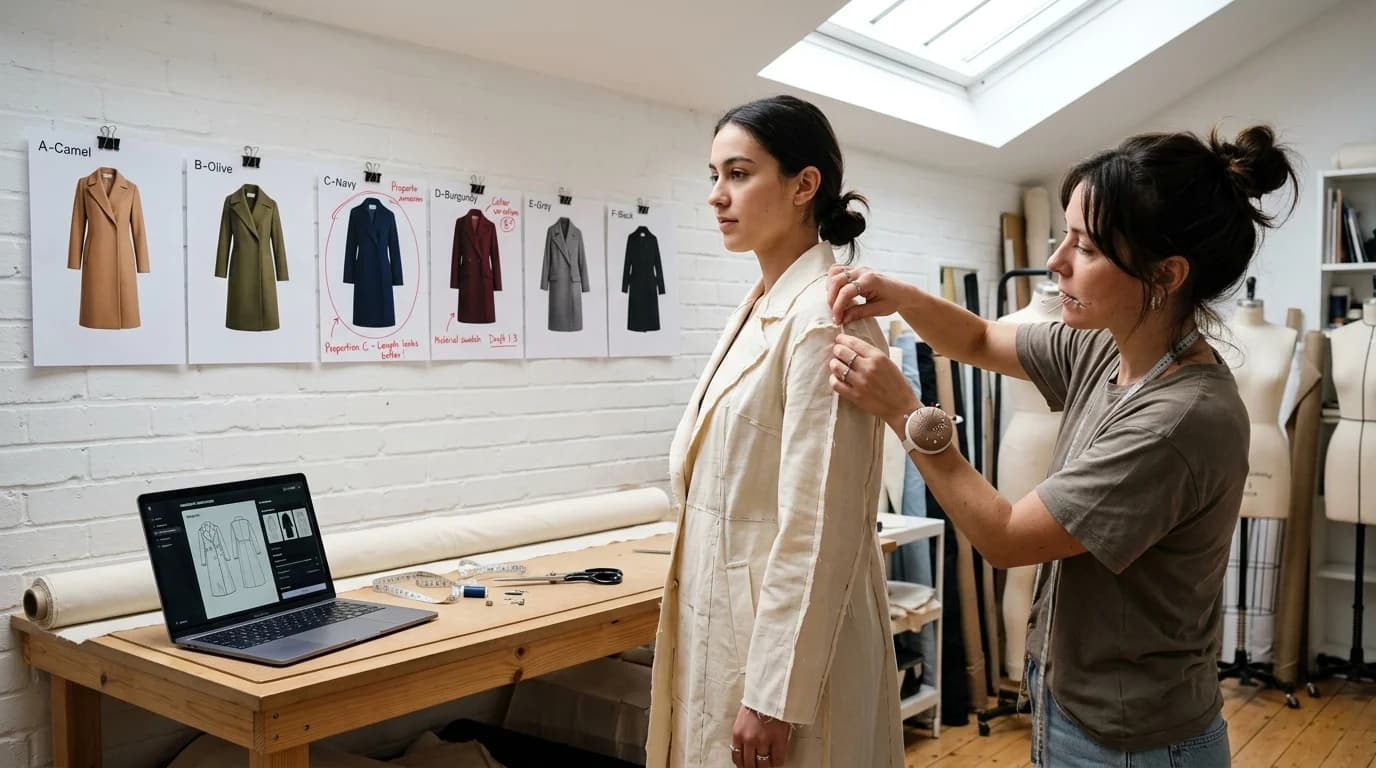
Emerging designers in 2026 treat AI the way architects treat CAD or musicians treat synthesizers. It handles specific moments in the process where speed, volume, or visualization matters. These designers still sketch by hand. They still drape on forms. They still cut patterns and sew samples. What AI does well: generate ten visual variations in five minutes instead of one in an hour.
Here's where AI actually sits in the design process for the emerging designers who build collections with it.
Stage 1: Research and mood boarding
AI finds its strongest foothold here. Traditional mood boarding means gathering existing images: magazine tears, Pinterest boards, film stills, fabric swatches. The board communicates a direction, but a wide gap sits between those reference images and the eventual garments. The designer bridges that gap with imagination and skill.
AI mood boards close it from the other side. Instead of collecting images of other people's work that approximate the idea, designers generate images of their own ideas directly. "What does a cocoon coat in burgundy wool look like under overcast light?" takes 30 seconds to answer with AI. Without AI, that question waits six months until the sample is made.
The designers we've spoken to use AI mood boards two ways. Some treat them as a private thinking tool, generating dozens of variations to clarify their own vision before they touch fabric. Others bring them into client presentations, showing prospective stockists or collaborators what the collection will look like before production begins.
Stage 2: Silhouette exploration
Before committing to a pattern, designers need to test shapes. Traditional exploration means draping muslin on a form or sketching variations on paper. Valuable work. Slow work.
AI lets designers test silhouette variations at volume. "Show me this bodice with an empire waist, a natural waist, and a dropped waist" produces three options in three minutes instead of three hours. The AI-generated versions lack the precision for pattern-making, but they are precise enough to pick a direction.
Several designers call this "cheap mistakes." They'd rather discover that a proportion fails in a 30-second AI generation than in a three-hour draping session. AI absorbs the cost of wrong turns.
The designers who do this well still drape and sketch. AI doesn't replace muslin. It adds a step before muslin where the worst ideas get killed before any fabric is cut.
Stage 3: Fabric and color visualization
Fabric swatches and color chips have physical limits. You can hold a swatch of silk charmeuse in champagne, but you cannot see what it looks like as a finished garment without making the garment. AI fills that visualization gap.
"How does this A-line silhouette look in midnight velvet versus champagne silk charmeuse?" Designers ask that question constantly, and AI answers it with generated images that get close enough to inform the decision.
The limitation is real: AI color lacks pixel accuracy. A generated "champagne" might not match the real swatch. Smart designers treat AI color as directional. They narrow options with AI, then confirm the final choice against physical references.
Stage 4: Lookbook and presentation imagery
This is where the money matters most. Before a collection is produced, designers need images for pre-orders, wholesale presentations, press kits, and social media. That traditionally requires a full lookbook shoot: models, photographer, studio, post-production. For an emerging designer, the shoot can cost more than the fabric for the entire collection.
AI lookbook generation cuts that cost to a fraction. A designer can produce a 10-look lookbook with consistent lighting and framing in a day, paying for generation credits instead of a production crew.
The caveat is worth stating plainly: AI lookbooks work for pre-orders and preliminary presentations. For the final campaign, most designers still shoot real photography. The subtleties of fit on a real body, real fabric behavior, and real lighting remain beyond what AI produces. AI lookbooks are a bridge to production, not the destination.
Stage 5: Social content and marketing
After a collection is produced, AI generates supplementary content for social media. Fabric motion clips for TikTok. Variation images showing a garment in colors that weren't produced. Mood-setting video for Instagram Reels. Style comparisons showing the same silhouette in different fabrics.
This content supplements real photography. The real shoot produces the hero images. AI produces the volume that social media demands.
What designers don't use AI for
Pattern-making. No designer we've encountered uses AI to generate patterns. Pattern-making requires precision that AI can't touch: seam allowances, grain lines, dart placement. This stays with hand work or specialized CAD software.
Fabric sourcing. AI can show you what tweed looks like in a generated image. It can't tell you which mill produces the best tweed at a price point your production can absorb. Sourcing runs on relationships.
Fit assessment. How a garment fits on a real body with real proportions is something AI approximates but doesn't solve. Designers still need fitting sessions with real people.
Final construction decisions. Whether to use a French seam or a serged edge, how wide to cut the seam allowance, where to place the darts: these are physical choices that require the actual fabric in hand.
What the designers actually say
The emerging designers who use AI well share one attitude: AI is useful for seeing things faster. It does nothing for the quality of the final garment. That still depends on the designer's skill with fabric, pattern, and construction. AI accelerates the decisions that lead to making. It doesn't improve the making itself.
Kartik Research, one of the LVMH Prize semi-finalists, uses AI for visualization but centers every collection on hand-woven textiles made by artisan communities. The AI and the craft exist in the same process without competing. AI shows what's possible. Hands make what's real.
That's where the smartest emerging designers have landed. AI for speed and volume in the conceptual phases. Traditional skill for execution. The two coexist because they solve different problems.
FAQ
Do real fashion designers use AI?
Yes, though not the way tech coverage implies. They use it for mood boarding, silhouette exploration, color visualization, and preliminary lookbook imagery. Pattern-making, construction decisions, and fit assessment remain entirely manual. AI handles visual thinking. The designer handles physical making.
Will AI replace fashion designers?
No. AI accelerates the early conceptual and visualization stages. The final garment still requires pattern-making, fabric knowledge, construction skill, and fitting, all physical disciplines that AI doesn't perform. Designers who use AI well call it a thinking tool, never a making tool.
What AI tools do fashion designers use?
Image generation tools for mood boards, silhouette exploration, and lookbook imagery. Video generation tools for social content and presentation clips. Most work through platforms with fashion-specific vocabulary and control, like Moire. General-purpose generators work too but demand more precise prompting.
Does AI change what emerging designers create?
The designs still come from the designer's vision, material knowledge, and craft skill. What changes is the speed at which options are explored and eliminated. A designer who tests 50 silhouette variations in AI before touching fabric makes sharper choices at the cutting table.