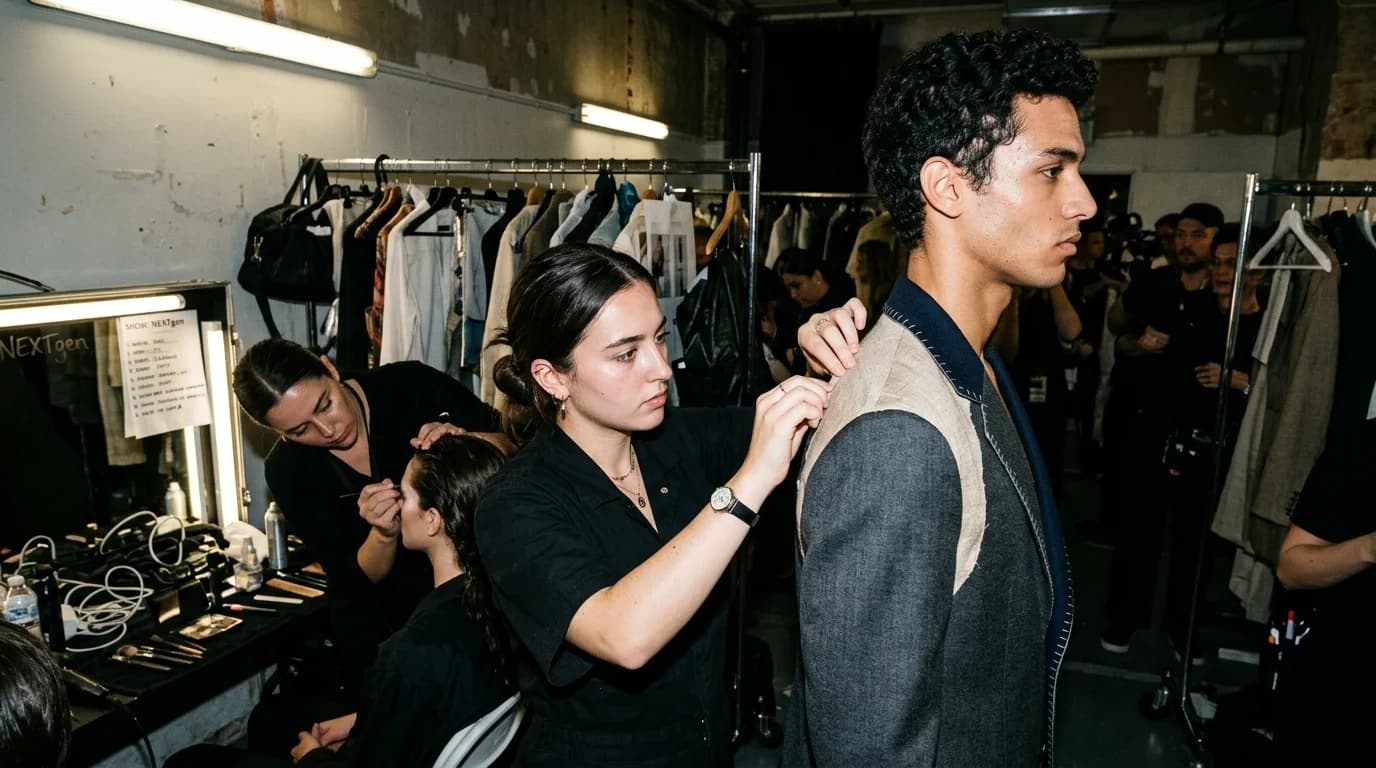
The LVMH Prize is the biggest launchpad in fashion for new designers. A 400,000-euro grand prize, a year of mentorship from LVMH specialists, and the kind of press attention that money cannot buy. Previous winners include Nensi Dojaka, S.S.Daley, and 2025 winner Soshiotsuki, all of whom went from relative obscurity to international recognition within months.
This year, the 13th edition, the committee selected 20 semi-finalists from 17 countries. That geographic spread is the story. Georgia, Kenya, Thailand, Iran, Colombia. The pipeline has widened far beyond the Paris-London-Antwerp axis that dominated for years.
Here's who made the cut, what their work says about fashion's direction in 2026, and which designers we think are the ones to remember.
The 20 semi-finalists
Act N°1 — Luca Lin (Italy, Genderless)
Luca Lin's genderless collections sit somewhere between tailoring and deconstruction. The draped constructions refuse to land in either menswear or womenswear, and they're more convincing for it. Act N°1 has been building a following through Milan Fashion Week, and this nomination feels overdue.
Colleen Allen (United States, Womenswear)
New York-based Colleen Allen is a fabric-first designer. Her womenswear is about what happens when construction changes how a textile moves on the body. Think bias-cut techniques and experimental draping. She's less interested in silhouette trends than in making textiles do unexpected things.
De Pino — Gabriel Figueiredo (France, Womenswear)
Gabriel Figueiredo's De Pino is research-driven womenswear. The brand lives in the tension between structure and softness: garments that hold architectural shapes with fluid materials. Quiet work. The kind of designer who gets more interesting each season.
Derrick — Luke Derrick (United Kingdom, Menswear)
Luke Derrick is doing the most compelling work with British tailoring on this list. He takes Savile Row construction methods and applies them to proportions that break from convention. The technique is traditional. The results are not.
Golshaah — Golnar Ahmadian (Iran, Womenswear)
Golnar Ahmadian brings Iranian textile traditions into contemporary fashion. Golshaah's womenswear draws on craft techniques that are centuries old, reinterpreted through modern silhouettes. She's one of the most geographically distinctive voices here, and the work backs it up.
Iamisigo — Bubu Ogisi (Nigeria, Womenswear and Menswear)
Bubu Ogisi's Iamisigo works with Nigerian artisan communities on materials and construction. The brand resists the "African fashion" label while being deeply rooted in the continent's making traditions. That tension between global fashion and local craft is what makes the work feel alive.
Institution — Galib Gassanoff (Georgia, Genderless)
The first Georgian designer to reach the semi-finals. Gassanoff's work draws on Georgia's position between Europe and Asia, mixing structured Western tailoring with Eastern draping. The cultural crossroads comes through in the garments themselves, which is harder to pull off than it sounds.
Julie Kegels (Belgium, Womenswear)
Julie Kegels is Antwerp-trained, and it shows. Her womenswear treats construction as an intellectual exercise. How a garment is built communicates something beyond its surface. This is the school of thought that produced Margiela and Dries, and Kegels is a worthy addition.
Kartik Research — Kartik Kumra (India, Womenswear and Menswear)
The "research" in the name is literal. Kartik Kumra starts with material investigation: hand-weaving, natural dyeing, artisan embroidery. Then he builds contemporary silhouettes around those processes. The work feels honest in a way that "heritage-inspired" collections rarely do.
Kinyan Lam (China, Genderless)
Kinyan Lam's genderless collections play with volume and proportion. Oversized constructions that create dramatic silhouettes while staying wearable. It's a narrow line to walk, and Lam walks it well.
Lii — Zane Li (China, Womenswear and Menswear)
Zane Li's Lii works across womenswear and menswear with a focus on material innovation, combining traditional Chinese textile techniques with contemporary production. The collections are strongest when the heritage elements are most visible.
Maz — Manuela Alvarez (Colombia, Womenswear)
Manuela Alvarez brings South American craft traditions into high fashion through Maz. She works with local artisan techniques, transforming regional processes into garments that hold their own internationally. Colombia has rarely been represented at this level of the prize, and Alvarez makes a strong case for why it should have been sooner.
Nong Rak — Cherry W. Rain-Phuangfueang and Teerapat Phuangfueang (United States/Thailand, Genderless)
A Thai-American duo producing genderless collections rooted in Thai textile heritage. Nong Rak represents something specific to this generation of designers: people who hold multiple cultural identities and let both show in the work, rather than flattening them into a single aesthetic.
Petra Fagerstrom (Sweden, Womenswear)
Petra Fagerstrom brings Scandinavian restraint and material precision, but with a personal edge that separates her from the minimalist default. Clean silhouettes, considered fabrication, and enough personality to make the quietness feel intentional rather than safe.
Ponte — Harry Pontefract (United Kingdom, Womenswear and Menswear)
Harry Pontefract's Ponte works across womenswear and menswear with an emphasis on innovative construction techniques. British-trained, with garments where the making process is visible and intentional. The structural experimentation is promising, though the brand is still finding its sharpest voice.
Shinyakozuka — Shinya Kozuka (Japan, Menswear)
Shinya Kozuka's menswear has the meticulous precision of Japanese designers who treat garment-making more like architecture than decoration. Clean lines, fabric chosen for how it behaves rather than how it looks. He follows in a strong tradition, and the work earns its place there.
Ssstein — Kiichiro Asakawa (Japan, Menswear and Genderless)
Kiichiro Asakawa's Ssstein experiments with proportional relationships between body and cloth. How changing one dimension of a garment shifts everything else. It's a narrow investigation, but the results are consistently interesting.
Thevxlley — Daniel del Valle Fernandez (Spain, Genderless)
Daniel del Valle Fernandez's Thevxlley comes from nightlife, music, and street culture. The genderless collections have a club-influenced energy that most prize nominees don't. Whether the LVMH jury rewards that raw sensibility over polished craft is an open question.
Tiscar Espadas — Tiscar Espadas and Kevin Kohler (Spain/Switzerland, Genderless)
A Spanish-Swiss partnership producing genderless collections. Southern European craft sensibility meets Swiss precision. The garments are technically rigorous and aesthetically warm, a combination that's difficult to achieve.
Yoshita 1967 — Anil Padia (Kenya, Womenswear)
The first Kenyan designer to reach the semi-finals. Anil Padia's Yoshita 1967 draws on East African making traditions for its womenswear. The inclusion expands the map of where fashion's emerging talent comes from, and the work is strong enough to justify it on merit alone.
What this shortlist tells us about 2026
Seventeen countries. First-time representation from Georgia, Kenya, and Thailand. The LVMH Prize has always skewed toward graduates of a handful of European and American schools. This year's list suggests the committee is actively looking beyond that pipeline, and the designers they've found are good enough to prove the pipeline was the problem, not the talent pool.
Seven of the 20 semi-finalists produce genderless or cross-gender collections. Five years ago, that would have been the headline. Now it's just how a large portion of emerging designers work. The question has shifted from "should fashion be gendered?" to "how do you design well without gender as a starting framework?"
The most telling pattern is the emphasis on craft. Kartik Research, Iamisigo, Maz, Nong Rak, Yoshita 1967 — they all center their work on artisan techniques and material knowledge. In 2026, when AI can generate images of any garment, the designers getting recognized are the ones who can actually make things. Hand skills and artisan collaboration are the moat.
Tailoring persists too. Derrick, Shinyakozuka, and others work within tailoring traditions, reinterpreting them rather than abandoning them. The precision of cut-and-sew construction still carries a credibility that draping and conceptual work alone don't provide.
The stakes
The grand prize winner gets 400,000 euros and 12 months of mentorship from LVMH Maison specialists. The Karl Lagerfeld Prize and Savoir-Faire Prize go to additional finalists. Last year, Soshiotsuki's win took him from niche Japanese menswear to international stockists within months.
For these designers, the prize is access. Access to production expertise, to the press, to buyers who would otherwise never encounter the work. Even reaching the semi-finalist stage generates visibility that most of these brands could never afford on their own.
Eight finalists will be selected from this group of 20. The final takes place later in 2026.
FAQ
What is the LVMH Prize?
The LVMH Prize for Young Fashion Designers is an annual competition run by LVMH (the luxury group behind Louis Vuitton, Dior, and Celine). It awards 400,000 euros plus a year of mentorship to one emerging designer. Now in its 13th edition, it's widely considered the best launch platform for new fashion talent.
Who won the LVMH Prize in 2025?
Japanese designer Soshiotsuki (Soshi Otsuki) won the 2025 grand prize for his menswear, recognized for impeccable tailoring and refined materials. British designer Steve O Smith won the Karl Lagerfeld Prize, and Torisheju Dumi won the Savoir-Faire Prize.
How many countries are represented in the 2026 semi-finalists?
Seventeen countries, including first-time representation from Georgia (Institution by Galib Gassanoff), Kenya (Yoshita 1967 by Anil Padia), and Thailand (Nong Rak). It's the most geographically diverse shortlist in the prize's history.
When will the 2026 LVMH Prize winner be announced?
The 20 semi-finalists presented at a showroom during Paris Fashion Week in March 2026. Eight finalists will be selected by the committee of experts, and the final ceremony takes place later in 2026. The exact date has not been announced.
Why does the LVMH Prize matter for fashion trends?
The shortlist works as a trend signal. The committee of 80+ industry experts picks designers whose work reflects where they think fashion is heading. When craft-focused, genderless, and geographically diverse designers dominate, that tells you something about what the industry's gatekeepers are betting on.