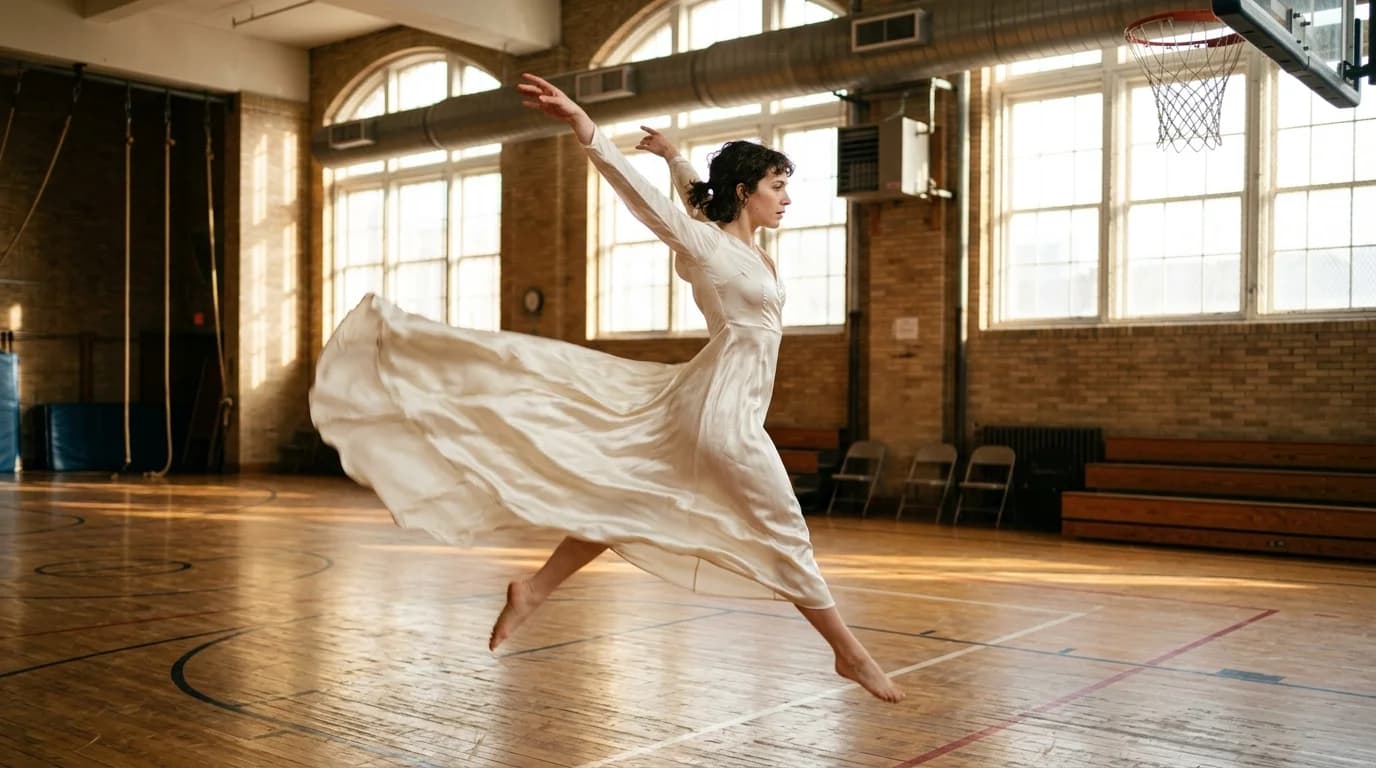
Fabric is where AI video falls apart. A static garment in a photo can look fine. Put it in motion and every gap in the AI's understanding of physics shows up. Silk moves like plastic. Wool ripples like water. Pleats multiply and vanish between frames.
Some fabrics do hold up, though. And when they hold up, the footage looks real. You just need to know which textiles the AI handles, which ones it ruins, and how to steer it toward the behavior you want.
This builds on our guide to what AI fashion video can produce in 2026. Here we go deeper on fabric specifically.
Why fabric motion is hard for AI
AI video models learn from footage. They have watched thousands of clips of fabric in motion, but they do not understand why fabric behaves as it does. There is no gravity model, no awareness of weight per square meter, no concept of thread count or weave.
What they have is pattern recognition. They know silk charmeuse in motion looks a certain way because they have seen enough of it. They know denim behaves differently from chiffon. But they guess between frames based on what looks plausible, not on simulated physics.
Fabrics with distinctive, repeatable motion patterns render well because the AI has strong references. Fabrics with complex, variable behavior fall apart because there is no physics engine to catch the AI when the patterns turn ambiguous.
Fabrics that work in AI video
Heavy, low-movement fabrics are your safest bet. Tweed, denim, heavy wool, leather. These barely move. A tweed blazer in a slow camera orbit looks convincing because the fabric does almost nothing. Texture stays consistent frame to frame when there's so little deformation.
Fabrics with predictable drape hold up in short clips. Silk charmeuse and satin have that characteristic liquid flow the AI has absorbed from thousands of training examples. A 3-5 second clip of a silk charmeuse dress swaying with a model's walk can pass for real footage. Keep it under five seconds, though. Past that, the drape drifts.
Structured sheers do better than you would expect. Organza keeps its crispness in motion. Because it holds shape rather than flows, the AI does not need to fake complex physics. An organza ruffle moves in a predictable arc, and the AI nails that.
Velvet works well for a specific reason. It absorbs light. Small motion errors that a shiny fabric would broadcast through warped reflections just disappear into velvet's matte depth. Crushed velvet with its irregular texture is even more forgiving.
Fabrics that break down
Lightweight sheers in wind are the worst case. Chiffon in a breeze demands the AI track dozens of independent fabric sections, all with different directions and speeds. The first 2-3 seconds look passable, then layers merge, clip through each other, or fold in impossible ways. Stack multiple chiffon layers and it gets worse fast.
Reflective fabrics fight the AI. Satin and metallics require the AI to recalculate light reflections as the surface angle shifts. Those reflections often lag behind the movement or land in physically wrong spots. Short clips mask it. Anything past five seconds makes it obvious.
Pleats in full motion are unreliable. Each pleat must hold its structure while the garment moves. Slow turns work. A full twirl or brisk walk blurs the pleats together, loses their edges, or adds phantom folds. Accordion pleats last longer than knife pleats because their rhythm is more regular and the AI can sustain the pattern.
Knits that stretch and recover expose the AI's blind spot. Jersey in a still shot is fine. Jersey on a body in motion, where it stretches over a bent knee then snaps back, reveals that the AI has no concept of elastic recovery. The stretch happens. The return does not always follow.
How to prompt for fabric behavior
Name the fabric. That alone is not enough. Add a behavior keyword that tells the AI how the fabric should move.
For silk charmeuse: "liquid drape, flowing movement, catches light as it moves"
For wool: "heavy drape, minimal movement, holds structure"
For organza: "crisp movement, holds shape, springs back after displacement"
For velvet: "dense pile, absorbs light, subtle movement"
For linen: "relaxed drape, natural wrinkle, gentle sway"
The behavior description primes the AI's pattern library. "Liquid drape" triggers a different set of motion patterns than "crisp movement," even when the fabric name alone could go either way.
Duration rules by fabric type
Not all fabrics hold up for the same clip length. Plan your storyboard around these limits:
| Fabric | Safe duration | Notes | |--------|--------------|-------| | Heavy wool, tweed, denim | 8-10 seconds | Minimal movement means minimal error accumulation | | Leather, suede | 6-8 seconds | Holds shape well but creasing can drift | | Velvet | 6-8 seconds | Light absorption hides errors | | Silk charmeuse, satin | 3-5 seconds | Beautiful but drape drifts after 5s | | Crepe, jersey | 3-5 seconds | Body-conforming fabrics need short clips | | Organza, taffeta | 4-6 seconds | Structure helps, but layering reduces duration | | Chiffon, tulle | 2-3 seconds | Lightweight sheers degrade fast |
These durations assume clips with movement. Static shots where the fabric barely moves can run longer across the board.
Cheating the physics
When you need chiffon in motion for more than three seconds, do not try to push the generation. Produce multiple 2-3 second clips and cut between them. Each clip starts clean. Cut before the physics fall apart and the illusion holds.
For pleated garments, slow the movement down. A model doing a measured quarter-turn in a pleated skirt works. A fast full twirl does not. Less movement buys more time before pleat definition collapses.
For reflective fabrics, control light. Soft, diffused light produces fewer specular highlights, which means fewer reflection errors. Save dramatic spot lighting for matte fabrics that will not fight you.
FAQ
Which fabrics look best in AI-generated fashion video?
Heavy, low-movement fabrics: tweed, denim, wool. These barely move, so the AI has less to get wrong. Velvet performs well because its matte surface hides motion errors. Silk charmeuse looks great in 3-5 second clips. Steer clear of lightweight sheers like chiffon past 2-3 seconds.
Why does AI struggle with fabric physics?
AI video models do not simulate physics. They guess between frames based on patterns absorbed from training footage. Predictable fabrics give the AI strong references. Complex, variable fabrics like layered chiffon in wind overwhelm that approach because the AI has nothing to fall back on.
How do I prompt for realistic fabric movement?
Name the fabric, then add a behavior term. "Silk charmeuse with liquid flowing movement" outperforms "silk charmeuse" alone because the behavior keyword tells the AI which motion patterns to pull from.
How long can fabric motion clips be?
It depends on weight. Heavy fabrics (wool, denim, leather) hold for 8-10 seconds. Mid-weight textiles (velvet, silk) work for 3-6 seconds. Lightweight sheers (chiffon, tulle) degrade after 2-3 seconds. Plan to produce several short clips and edit them together rather than pushing any single generation past its limit.