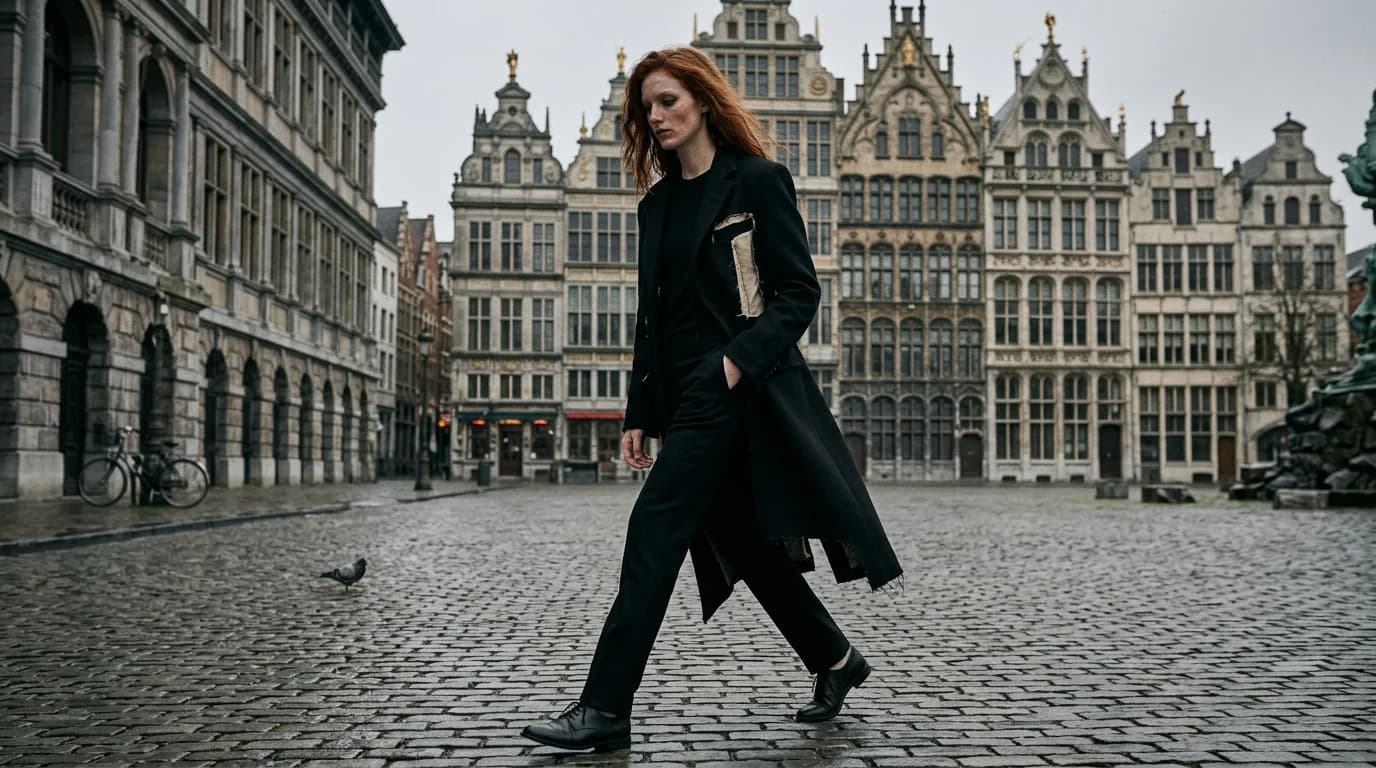
In 1988, six graduates of the Royal Academy of Fine Arts in Antwerp rented a truck, drove to the London fashion shows, and set up outside because nobody had invited them in. Dries Van Noten, Ann Demeulemeester, Walter Van Beirendonck, Dirk Van Saene, Dirk Bikkembergs, and Marina Yee. They became the Antwerp Six, and European fashion had to make room.
The school made them. The Royal Academy has spent 60+ years doing the same thing: producing designers who are technically rigorous, conceptually independent, and allergic to consensus. Raf Simons, Demna (Gvasalia), Haider Ackermann, Pieter Mulier. It hasn't stopped.
So what does the school actually do differently? And why should anyone tracking fashion trends today pay attention?
The curriculum that produces iconoclasts
The Royal Academy's fashion department sits inside a fine arts institution, not a design school. Everything follows from that.
Students think before they cut. First year is heavily conceptual. Students develop a point of view about what fashion is and what it should do before they learn the technical skills to execute it. At most other schools, CSM included, concept and technique develop in parallel. In Antwerp, concept comes first.
Individual voice is the metric. The program doesn't teach a house style. It teaches each student to find their own. Jury evaluations ask whether the student has a distinctive design language, not whether the garments sell or drape perfectly. A student with a strong voice and rough technique advances further than a student with perfect technique and no opinion.
Construction knowledge goes deep but stays functional. Students learn pattern-making, draping, tailoring, and textile manipulation. The technical foundation is serious. But the school treats these skills as tools for expressing the concept, never as ends in themselves. Antwerp graduates break rules confidently because they learned the rules well enough to know exactly what they're breaking.
The Antwerp Six legacy hangs over everything. Every student knows they follow Dries, Demna, and Raf. That legacy works as both resource (the school gets attention, the alumni network opens doors) and weight (graduating from the Royal Academy means immediate comparison to the best). The pressure sorts students into the ambitious and the overwhelmed. Ambitious ones make it through.
What Antwerp produces that other schools don't
Antwerp alumni share one quality: intellectual rigor applied to clothing. Some CSM graduates lean into dreamy conceptualism where the idea outranks the garment. Parsons and IFM graduates come out polished for commerce. Antwerp produces designers who hold a strong idea AND the construction skill to execute it at the highest level.
Dries Van Noten's maximalist layering rests on meticulous fabric sourcing and precise tailoring. Demna's oversized proportions at Balenciaga are pattern-cut with an exactness that casual observers miss entirely. Raf Simons's minimalism at various houses depends on structural decisions that cheaper execution would expose.
The school teaches one thing above all else: construction quality gives conceptual work its credibility. A deconstructed garment by someone who can't construct one? Just a bad garment. A deconstructed garment by someone who can build a perfect tailored jacket? That's a statement.
How Antwerp compares to other fashion schools
| Aspect | Antwerp (Royal Academy) | CSM | Parsons | Bunka | |--------|------------------------|-----|---------|-------| | Primary lens | Concept-first, fine arts context | Experimentation, cross-discipline | Commercial viability, industry prep | Technical mastery, precision | | Signature strength | Intellectual rigor + construction | Creative risk-taking | Industry readiness | Construction excellence | | Alumni archetype | Designer with a thesis | Designer with a spectacle | Designer with a business plan | Designer with a pattern | | Teaching method | Individual voice development | Broad creative exploration | Industry simulation | Technique-first, concept follows |
Antwerp's graduates stand out through the combination of a strong intellectual position and the technical ability to back it up in fabric.
The 2026 graduates and current direction
Current Antwerp graduates carry the tradition forward, with some notable shifts. Julie Kegels, a 2026 LVMH Prize semi-finalist, works within the school's tradition of construction as intellectual exercise.
The 2026 graduate show at the Royal Academy points in a few directions:
Material investigation over narrative. Like their CSM counterparts, Antwerp graduates lead with material rather than story. But where CSM students often use material as concept (what does felted wool mean?), Antwerp students use material as engineering problem (how can felted wool hold a tailored shoulder?).
Scale and proportion games. Antwerp has always played with proportion. Demna's oversized silhouettes are the most visible proof. Current graduates push further: garments where one dimension (width, length, or depth) gets dramatically exaggerated while the others stay conventional. The result looks recognizably Antwerp without copying any specific alumnus.
Sustainability through material intelligence. Not sustainability as marketing copy. Sustainability as the natural result of understanding materials. When you know how fibers behave, you waste less. When you can construct precisely, you don't over-cut. Technical emphasis, it turns out, generates less waste than a concept-heavy approach with loose construction.
Why Antwerp matters for trend watching
Antwerp's pipeline runs on a different clock. CSM graduates tend to surface fast; London's fashion press amplifies them within months. Antwerp graduates surface slowly, often in anonymous roles at other houses for years before launching their own labels. Raf Simons graduated in 1991 and didn't get widespread international attention until the early 2000s. Demna stayed unknown outside fashion circles until Vetements broke through around 2014.
So Antwerp's influence often looks invisible in the moment but becomes obvious in retrospect. The deconstructionism trend of 2026 has deep roots in work that Antwerp graduates did 5-10 years ago. The current emphasis on visible construction as a design language traces directly back to the school's founding philosophy.
If you track fashion trends, treat Antwerp as a leading indicator. What the Royal Academy graduates explore today shows up in mainstream fashion 5-7 years later. Longer lag than the LVMH Prize or ANDAM, but the signal tends to be more original. The fine-arts orientation pulls ideas from places that commercially focused schools never look.
FAQ
What is the Antwerp Six?
Six graduates of the Royal Academy of Fine Arts in Antwerp who broke into international fashion in 1988: Dries Van Noten, Ann Demeulemeester, Walter Van Beirendonck, Dirk Van Saene, Dirk Bikkembergs, and Marina Yee. They put Antwerp on the fashion map and proved that designers from outside Paris, Milan, London, and New York could compete at the top.
How does Antwerp compare to Central Saint Martins?
CSM runs experiment-first inside a cross-disciplinary design school. Antwerp runs concept-first inside a fine arts school. CSM produces designers with big spectacle energy. Antwerp produces designers with strong intellectual positions backed by construction skill. Both produce top-tier talent, but the design personalities differ.
Why do Antwerp graduates take longer to become famous?
The school prioritizes individual voice over commercial readiness. Graduates often spend years refining their vision in relative obscurity before breaking through. London's press ecosystem amplifies CSM graduates faster, but Antwerp alumni tend to build longer, more creatively independent careers.
Is the Royal Academy only known for fashion?
No. It's a fine arts institution that happens to have a fashion department. That broader art context shapes how fashion gets taught there: as cultural expression, not an industry skill.