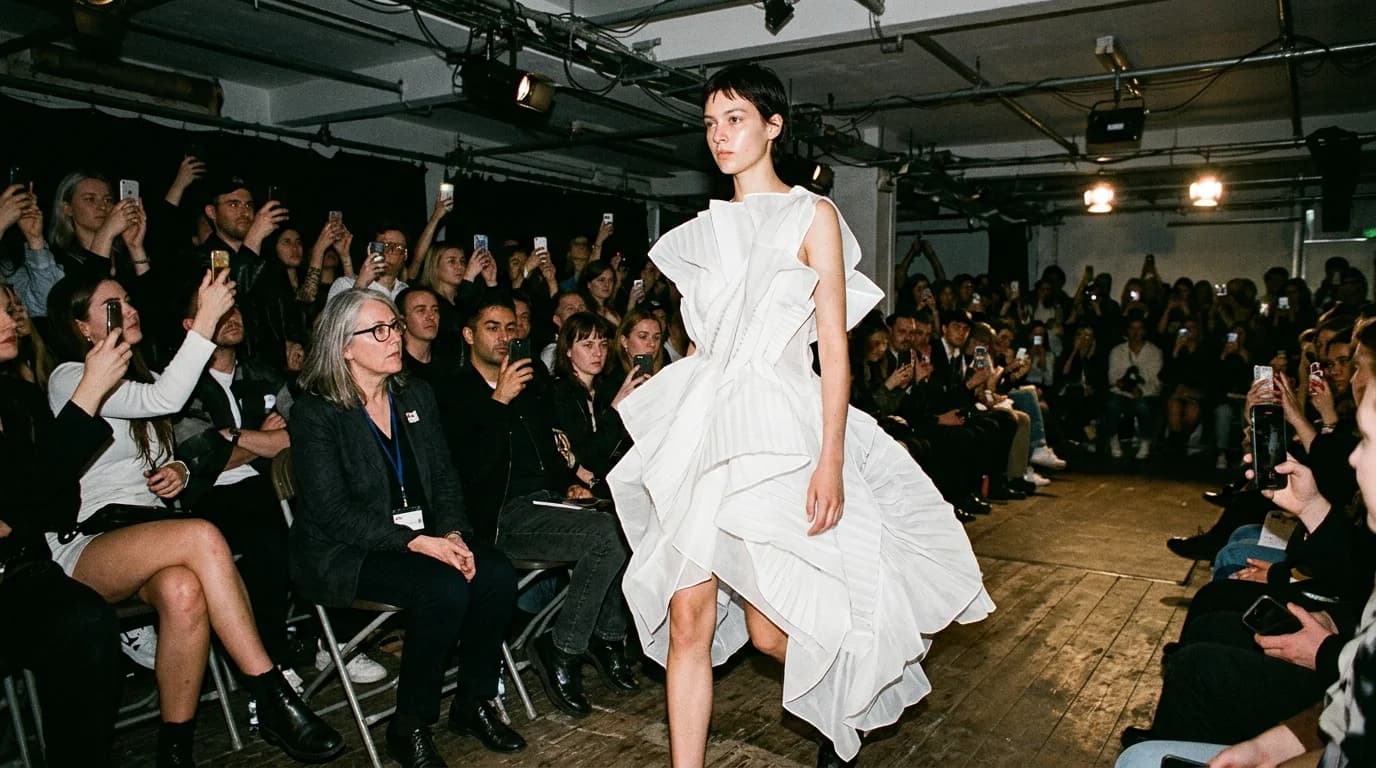
Central Saint Martins produces more noise per graduate than any other fashion school. Alexander McQueen, John Galliano, Stella McCartney, Phoebe Philo, Riccardo Tisci. The alumni list is stacked with designers who reshaped the industry on their own terms. Recruiters, buyers, and press watch the graduate shows accordingly.
That attention is deserved. It also warps perception. Not every CSM graduate is a genius. But when 30-40 fashion students collectively choose to explore the same territory, the aggregate signal tells you something real about where young designers think fashion should go. They've spent 3-4 years at the edge of the discipline. Their degree shows are a weather report.
This article covers what the 2026 CSM graduate collections, both BA and MA, reveal about the direction of fashion.
What the BA collections are showing
The BA Fashion show is the larger spectacle. More students, wider range, more experimental because the stakes are lower (it's an undergraduate degree, not a career launch). The patterns across 30+ collections are the signal.
Volume is back, but it's structural. Multiple BA graduates this year work with exaggerated silhouettes. Not the billowy, fabric-heavy volume of a few years ago. Architecturally constructed volume. Padding, boning, internal structures that hold shape independent of the body. Think scaffolding under cloth. The cocoon shapes are precise rather than floppy, which tells you these students have been studying construction technique as hard as concept.
Material research replaced narrative. Five years ago, the strongest BA collections led with story: a designer's personal history, a cultural reference, a political statement. This year, the strongest collections lead with material investigation. What happens when you bond two fabrics? What does handmade felt look like as tailoring? Can you build structural garments from waste textiles? The concept follows the material. The material no longer serves a predetermined story.
Gender has dissolved. Nobody at CSM treats this as a statement anymore. The collections that explicitly address gender feel dated next to the ones that just ignore it as a category. The best work comes from designers who build garments for bodies without sorting those bodies into men and women first.
What the MA collections are showing
The MA Fashion show is smaller, more focused, and more commercially aware. MA students are older, often with industry experience. Their collections tend to be more resolved and closer to what might actually sell.
Craft as credibility. The MA students are going hard on hand techniques. Hand-stitching visible in finished garments. Hand-woven textiles. Hand-finished edges. AI can now generate images of any garment instantly. The students who can prove they actually made the work hold a different kind of advantage. Same pattern we see in the LVMH Prize semi-finalists. Craft is the differentiator.
Sustainability without slogans. The MA collections that deal with sustainability do it through material choices and construction methods, not artist statements. Deadstock fabrics, mono-material construction (garments from a single fiber type for recyclability), zero-waste pattern cutting. The argument lives in the garment, not the press release. Far more convincing than what we saw two years ago.
Tailoring is alive. Several MA graduates work within tailoring traditions — proper canvassing, proper seaming, proper pressing — while subverting the proportions. Luke Derrick at the LVMH Prize does the same thing. A whole generation learned the rules of tailoring and now breaks them on purpose rather than out of ignorance.
The names to track
We won't know which specific graduates break through until the industry has had a year to respond to their work. But based on the collections, these directions are worth following:
Graduates at the intersection of textile craft and structural innovation. The ones who can weave or felt their own fabric AND cut it into something you'd wear. That double competency is rare and valuable.
Graduates who treat construction as visible design. Exposed seaming, visible basting, deconstruction techniques that show the work rather than hide it. Margiela did this 35 years ago. The current version is more refined and less theatrical.
Graduates who actually flat pattern cut and tailor. These skills got deprioritized in fashion education over the past decade. The students who have them stand out because almost none of their peers do.
What CSM degree shows predict
CSM graduate collections have a decent forecasting track record. Not every graduate succeeds, obviously. But the aggregate themes tend to foreshadow what appears in professional collections 2-3 years later.
When CSM graduates collectively focused on deconstruction in the late 1990s, deconstruction dominated the following decade. When sustainability themes saturated the 2015-2018 degree shows, sustainability became the industry's central conversation by 2020. Genderless design dominated the 2018-2020 shows; the broader industry followed by 2022.
The 2026 signals: structural volume, material-led design, visible craft, and pattern-cutting precision. If the pattern holds, expect these across emerging designer collections through 2028-2029.
The caveat
CSM's dominance in fashion education discourse is partly earned and partly self-reinforcing. The school gets the most press because it has the most famous alumni, which attracts the most ambitious applicants, which produces the most press-worthy graduates. Other schools — Antwerp's Royal Academy, Bunka in Tokyo, Parsons in New York, Polimoda in Florence — produce work just as strong. CSM just has the loudest megaphone.
Read the work, not the institution. The Antwerp effect is just as real. Bunka's technical rigor often surpasses CSM's. And the most interesting developments in fashion education right now might be at schools with no legacy to trade on at all.
FAQ
Why does CSM matter for fashion trends?
The school produces a large share of the designers who go on to lead major houses and independent labels. The collective themes in their graduate shows tend to foreshadow professional fashion trends 2-3 years ahead.
What's the difference between CSM's BA and MA fashion shows?
The BA show is larger, more experimental, and more conceptual. The MA show is smaller, more resolved, and closer to commercial viability. MA students tend to be older with industry experience. Both attract serious industry attention.
How do CSM graduates get discovered?
The degree shows draw recruiters from major fashion houses, buyers from multi-brand retailers, and fashion press. Winning or being shortlisted for the L'Oréal Professionnel Creative Award (given at the show) puts graduates on the radar fast. The school's alumni network also helps with placement.
Are CSM graduates always the best emerging designers?
No. The school's reputation gives its graduates a visibility advantage others don't have. Antwerp, Bunka, Parsons, and Polimoda all produce work at the same level. CSM gets more attention because of its alumni legacy and London's fashion press ecosystem.