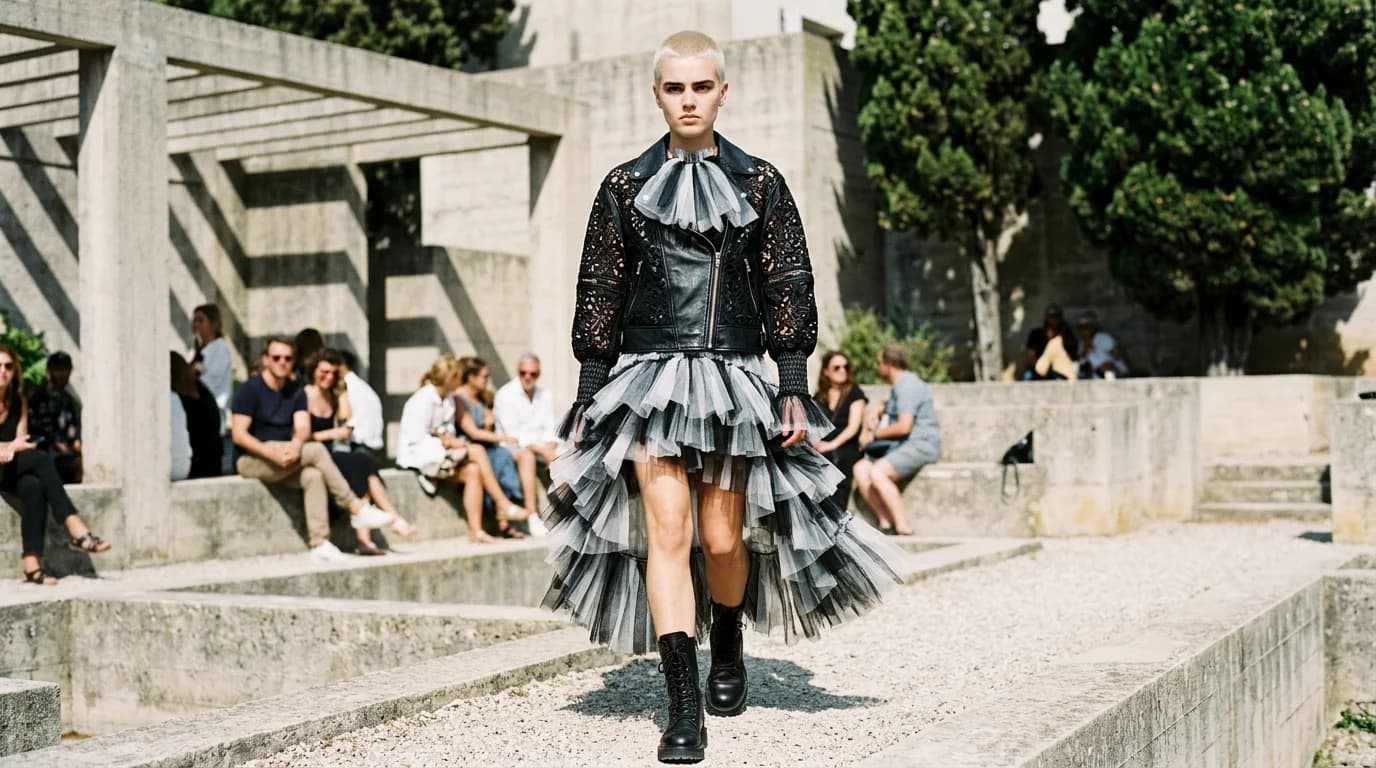
Hyères is the weird one. The LVMH Prize and ANDAM reward designers who could plausibly run commercial businesses. The International Festival of Fashion, Photography and Fashion Accessories in Hyères rewards work that might not sell a single unit. That gap is the whole point.
Founded in 1986, held every year at Villa Noailles on the French Riviera, the festival spans fashion, photography, and accessories. The fashion competition draws designers who treat garments as art practice. Their work is stranger and more material-obsessed than anything at the commercial prizes. A lot of it fails. The best of it fails on purpose.
LVMH tells you who will lead fashion houses. Hyères tells you what the outermost edge looks like right now, before anyone else bothers to look.
What makes Hyeres different
The festival is small. The audience is niche: curators, gallerists, fashion academics, a handful of press who cover the conceptual end. Villa Noailles, a 1920s modernist house, sets the tone with its own architecture. Rigorous. Experimental. Historically loaded.
Ten finalists present on a runway. The jury mixes designers, artists, curators, and editors, a broader pool than the industry-heavy panels at LVMH or ANDAM. The jury skews toward concept and craft. Commercial viability is someone else's problem.
Prize money is modest next to LVMH and ANDAM. But the festival offers production support for the finalist collection, studio access at Villa Noailles, and a residency. If your work lives closer to art than commerce, those resources beat cash.
What the 2026 edition reveals
Material as concept. The strongest finalists this year let the material itself carry the design. Not the silhouette, not the shape. The stuff. Hand-felted wool that doesn't drape but cracks. Paper garments that fall apart over days. Textiles that wouldn't survive a week in a wardrobe. Nobody pretends they should.
Compare the fabrication shift toward natural fibers we track elsewhere. Commercial designers pick natural fibers because customers want them. Hyères finalists pick bizarre materials because they want to see what happens. Same material obsession, completely different motivation.
Photography and fashion as one practice. Hyères stands alone in running fashion and photography competitions side by side. Several 2026 finalists work across both, making garments built for the camera rather than the body. The garment exists as a photograph. The three-dimensional object is just a step in that process.
Most of fashion keeps a tidy hierarchy: clothes are things you wear, photos are how you show them. Hyères collapses that. A dress designed for a specific location, specific light, specific time of day belongs as much to photography as to fashion. We think more designers should try it.
Process as product. Several finalists present work where the making IS the design. Garments that document their own construction. Thread visible at five times its normal scale. Patternmaking choices no commercial maker would touch, because the construction itself is the entire statement.
The deconstructionism trend in commercial fashion gestures at this, but pulls back before anyone gets uncomfortable. Hyères doesn't pull back. Some of these pieces abandon wearability entirely so the process stays visible, and the work is better for it.
The Hyeres-to-market pipeline
Hyères finalists don't always go commercial. Some stay in the art world, some teach, some vanish entirely. But the ones who do cross over carry a conceptual backbone that shows up in everything they make.
The typical path: Hyères finalist, gallery shows and residencies for a few years, first commercial collection around year three to five, then an independent label or a creative director seat at a brand that actually wants ideas. It's a slow track. The designers who take it arrive with a design language they built on their own terms, not one they borrowed from the market.
Slower than LVMH-to-stockist. Worth the wait.
Why it matters for trend forecasting
Hyères runs 5-10 years ahead of the mainstream. Material experiments shown there filter into commercial collections over the next decade. Hand-felting techniques from Hyères 2020 now show up in emerging designer collections. Deconstructionist ideas that looked purely academic at the festival are now commercially viable.
The lag is longer than for LVMH or ANDAM, but the signal goes deeper. Want to know what fashion looks like in 2030? LVMH tells you who'll make it. Hyères tells you what ideas they'll work with.
For AI fashion generation, Hyères finalists build the visual vocabulary that eventually enters training data. The silhouettes and construction techniques on display today become promptable concepts in two to three years once the imagery hits training pipelines.
Villa Noailles as context
The building is part of the argument. Charles and Marie-Laure de Noailles commissioned the villa in 1923. They backed Man Ray, Giacometti, Dalí, Buñuel. A century of avant-garde patronage soaked into the place. Fashion shown there sits in direct conversation with fine art, a framing most fashion prizes go out of their way to avoid.
And it filters the applicant pool. Designers who see fashion as cultural practice apply here. The ones chasing retail strategy apply elsewhere. Good.
FAQ
What is the Hyères Festival?
The International Festival of Fashion, Photography and Fashion Accessories, held annually at Villa Noailles in Hyères, France since 1986. A competition for emerging fashion designers and photographers, with a strong bias toward conceptual and experimental work over commercial readiness.
How is Hyères different from the LVMH Prize?
LVMH wants creative vision you can sell. Hyères wants ideas that might never sell. Finalists at Hyères often spend three to five years in residencies and exhibitions before launching any commercial work, if they launch commercial work at all.
Why should fashion trend watchers follow Hyères?
Because it runs 5-10 years ahead. Material experiments and construction techniques from Hyères filter into commercial fashion slowly but reliably. LVMH tells you who will make the clothes. Hyères tells you what ideas those clothes will contain.
Can Hyères designers build commercial businesses?
Some do, on a longer timeline. They tend to spend years in the art world first. When they do go commercial, the collections have a conceptual depth you can trace straight back to the festival work. The extra years show.